


Summary:
- Amgen is using artificial intelligence (AI) to help design new proteins with therapeutic properties considered from the start, accelerating discovery of next-generation medicines.
- The company's AMPLIFY protein language model, co-developed with Mila, teaches AI the language of proteins to make protein engineering faster, smarter and more accessible.
- By combining AI, automation and biology, Amgen has leveraged its generative biology platform to triple protein engineering speed and cut discovery timelines in half.
At Amgen, science has always been about pushing boundaries. From pioneering recombinant protein therapies in the 1980s to today's advanced biologics, Amgen researchers have embraced new tools to deliver for patients.
Today, artificial intelligence (AI) is the latest tool transforming ways of working—enhancing, not replacing, the role of scientists.
By merging biology, AI and automation, Amgen researchers are moving beyond discovery to designing biologic medicines with precision and intent.
From Searching to Designing: The Shift to Generative Biology
For decades, biologic drug discovery meant screening thousands of natural proteins in hopes of finding one that worked. Progress was slow and unpredictable—like hunting for a “needle in a haystack.”
Today, that model is being replaced by generative biology, an approach that integrates biology, machine learning and automation to design new proteins rather than search for them. Amgen scientists can now build proteins with desired therapeutic properties using AI-assisted design.
“We're moving from a 'search and discover' model to a 'design and generate' way of thinking about biological function,” says Marissa Mock, executive director of the Generative Biology group in Research and Development at Amgen. “The more data we feed into our models, the better, faster and more successful we become at making the proteins we want.”
For example, Amgen researchers developed a machine learning model that predicts viscosity—a property critical to injectable medicines—with approximately 80% accuracy in internal evaluations. This predictive capability helps reduce the risk of late-stage failures and increases the likelihood of clinical success.
AlphaFold: The AI Breakthrough That Sparked a Revolution
The rise of generative biology builds on a major scientific breakthrough. In 2020, DeepMind's AlphaFold model showed that AI could predict how proteins fold into 3D structures almost as accurately as experimental methods. This was a milestone in computational biology and AI for drug discovery.
For decades, scientists had struggled with the “protein folding problem”—how a protein's amino acid sequence folds into the complex 3D structure that determines its function. AlphaFold took a major step toward solving this challenge, reducing structure prediction from months or years to days and accelerating discoveries across biology and medicine.
But predicting structure alone isn't enough to make a medicine. Properties such as how stable a protein is, how easily it can be manufactured and if it's likely to trigger an immune response are all equally important.
The next frontier is predicting function: how proteins behave in the body and during manufacturing. By going directly from sequence to function and bypassing the complexities of a protein's structure, scientists can anticipate performance more efficiently and potentially design better drug candidates from the start.
AMPLIFY: Teaching AI the Language of Proteins
To advance that goal, Amgen partnered with Mila, a Montreal-based AI Institute, to create AMPLIFY, an AI-powered protein language model that uses sequence to help predict function.
Just as large language models predict words in a sentence, AMPLIFY predicts patterns in amino acid sequences that reveal how proteins are likely to behave. Its advantage is that it uses higher-quality datasets, enabling faster, more efficient training with less computing power. This makes advanced protein design more accessible to scientists everywhere.
AMPLIFY is also open source, empowering researchers worldwide to use and improve it, helping expand the reach of generative biology across research and industry.
“AMPLIFY gives us the ability to engineer proteins nature may never have created,” says Christopher Langmead, executive director of AI & Data for Engineered Biologics. “It not only helps us design new types of proteins, it also helps make them easier to develop by improving stability, solubility and how well they can be manufactured.”
Federated Learning: Learning from and Sharing Data Securely
Amgen is also exploring the use of federated learning, which lets organizations train AI systems collectively without sharing raw data. Because no single company has enough protein data to capture biology's full diversity, federated learning broadens models' understanding while protecting data privacy, with the potential to accelerate discovery across the field.
These models are designed to incorporate data from past experiments—including negative findings—helping scientists avoid repeating past mistakes. Each negative result becomes a valuable data point that strengthens future predictions, improving accuracy and efficiency.
This learning-from-failure approach helps shorten development timelines, conserves resources and accelerates the path from design to patient.
A Generative Loop: Where AI Meets Automation
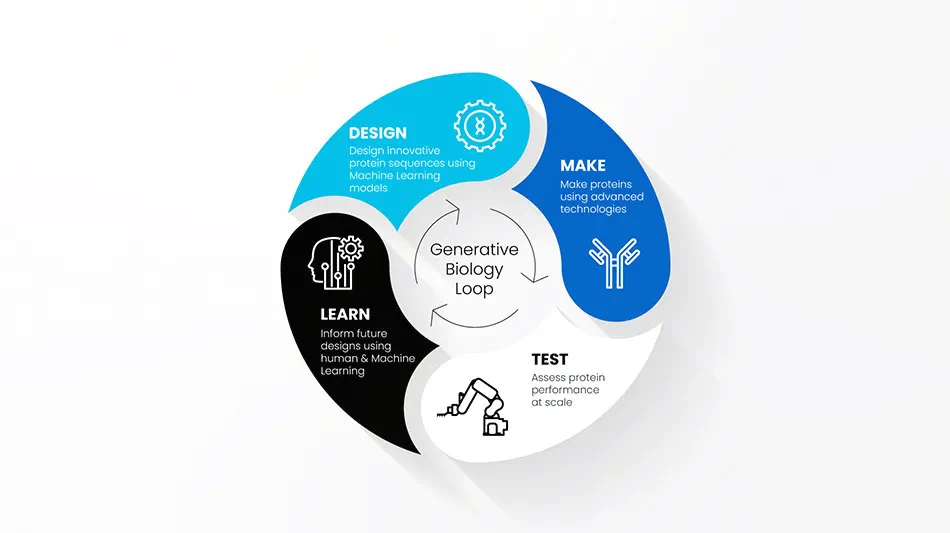
To put these AI tools to work at scale, Amgen has developed an integrated “design → make → test → learn” generative loop, where AI and automation continuously refine each other. In this loop:
- AI designs proteins with desired properties.
- Robots make and test them at scale.
- Results feed back into the AI model, improving its predictions.
Researchers oversee the process, ensuring human insight guides every step. This loop has already tripled the speed of protein engineering and cut discovery timelines in half.
High-throughput automation further minimizes bottlenecks, scales operations efficiently and helps Amgen bring more potential therapeutics forward faster.
The Power of People and the Promise of AI in Biotech
Looking ahead, AI is poised to help Amgen create next-generation biologic medicines for patients that are more precise, effective and predictable—from early design to manufacturing. Yet AI is only as powerful as the scientists who guide it.
“AI is a catalyst, not a replacement for science,” says Howard Chang, senior vice president of Global Research and chief scientific officer at Amgen. “When we unite technology with biology, we expand what's possible for patients.”


