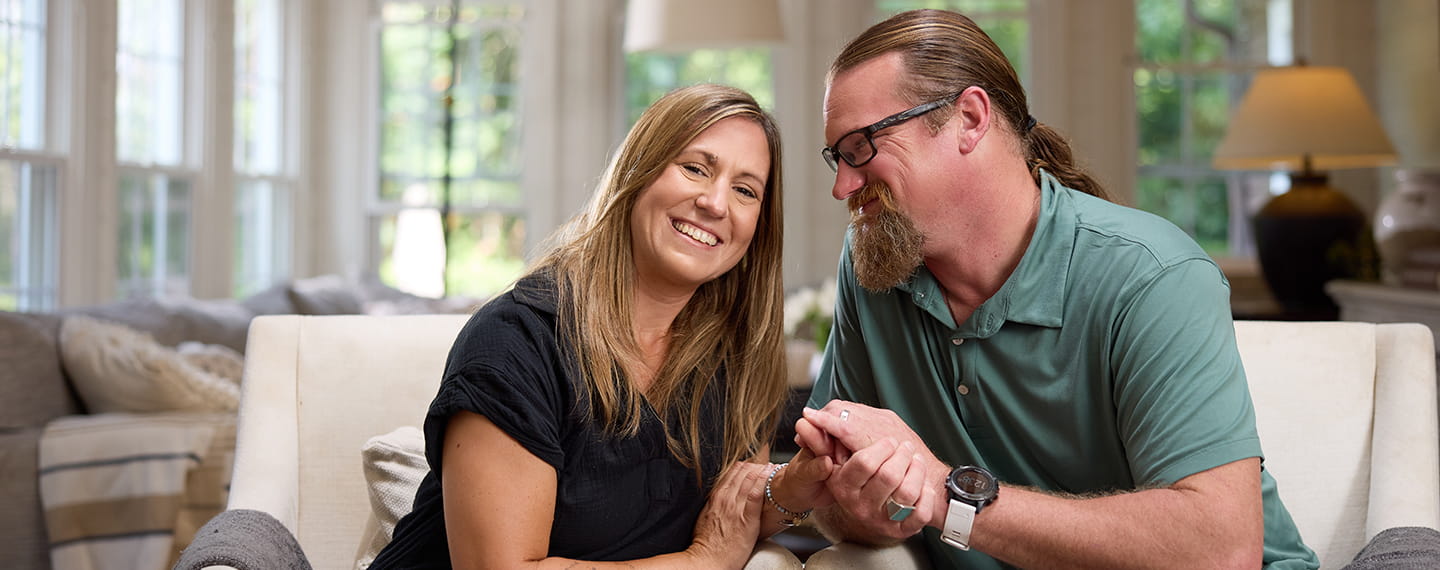
Andy Provencher landed with a thud and a crack. He had flipped over the handlebars while mountain biking. He went to the hospital expecting broken bones. What he didn't expect was for doctors to also find that his lungs were plagued with shadows and masses. He was told he might have an aggressive form of cancer. After a subsequent biopsy was inconclusive, Andy underwent a months-long journey in search of answers.
“I saw every kind of doctor, so many '-ologists!' I went through a six-month period of receiving many different diagnoses,” Andy said. “Eventually, I received a voicemail from a doctor that I still listen to today: 'We know what this is, and we know how to treat it.'”
That doctor, John Stone, M.D., a rheumatologist at Massachusetts General Hospital, diagnosed Andy with IgG4-RD, a rare disease that can look like many other diseases. IgG4-RD can drive inflammation across multiple organs, earning it the nickname “the great mimicker.” 1,2 Symptoms can resemble those of Sjögren's syndrome, lupus, vasculitis, certain digestive diseases or even some cancers, contributing to a long and complicated path to diagnosis.1-3
It's estimated that IgG4-RD affects 5 in 100,000 people in the U.S.4 Many people may have never heard of it, and many healthcare providers may never encounter a case. With a newly-recognized rare disease, greater awareness may ultimately reveal that it is more pervasive than previously understood. For a disease as rare and complex as IgG4-RD, raising awareness and addressing critical gaps in care requires more than individual efforts—it demands collaboration.
Turning Up the Volume Together
Diagnosing and managing IgG4-RD often requires multidisciplinary care, with many different healthcare providers and specialists working together.2 In rare disease, patient advocacy organizations provide critical guidance, connection and support. Progress often depends on joining forces around a shared goal, recognizing that collective voices can drive greater understanding and momentum than any one group alone.
“Progress in IgG4-RD depends on collaboration,” said Jasper van Grunsven, senior vice president, Rare Disease & Global Commercial Capabilities and Innovation at Amgen. “When we extend awareness beyond a single community—particularly to conditions that IgG4-RD may mimic—we improve our chances of connecting with patients who remain undiagnosed.”
That's why AiArthritis, the American Kidney Fund, the Global Healthy Living Foundation, the IgG4ward! Foundation, Mission: Cure, Vasculitis Foundation and Amgen are aligned around a shared goal of raising awareness of the signs and symptoms of IgG4-RD and supporting earlier recognition.
“No single organization can raise awareness or address these challenges alone,” explained Angela Degrassi, senior manager, Patient-Centered Research Operations & Engagement at the Global Healthy Living Foundation. “Collaboration allows advocacy organizations to pool expertise, share lessons learned, and amplify messaging.”
Creating Collaborative Pathways to Care
Following Andy's diagnosis, his wife Katharine soon began to channel her expertise as a social worker into the IgG4-RD community, joining Dr. Stone's advocacy organization, the IgG4ward! Foundation, as director of advocacy and community engagement. For Katharine and IgG4ward!, addressing IgG4-RD often means helping patients connect with the right support across disease areas to fully address their symptoms and find the right care.
“Advocacy organizations bridge lived experience with clinical expertise,” Katharine explained. “We collaborate with key opinion leaders while centering the patient voice. We translate complex medical information into practical, compassionate guidance so patients and their families can access reliable resources and community support.”
This collaboration between advocates and healthcare providers across disciplines creates multiple points of entry for patients. Someone struggling with unexplained kidney issues might connect with the American Kidney Fund, while another person experiencing joint inflammation might find resources with AiArthritis. Together, these organizations can guide patients toward diagnosis, regardless of where their journey begins.
The Power of Connection
The impact of collaboration extends beyond sharing resources and includes building networks of support that meet patients where they are. “Connection strengthens awareness,” Katharine shared. “By educating and collaborating within the larger rare disease space, we increase the likelihood that patients will recognize symptoms and reach accurate diagnoses sooner. The more we work together, the more powerful our collective advocacy becomes.”
At one time, little was known about IgG4-RD, but now, thanks to advocacy organizations working together, there is a growing community ready to support those impacted by this rare disease.
For other families navigating a rare disease diagnosis, Katharine's advice is simple: “Take a deep breath, seek out trusted sources of information, and find connection. Human connection is one of the most powerful tools families have.”
References
- Stone JH, Zen Y, Deshpande V. Mechanisms of disease: IgG4-related disease. N Engl J Med. 2012;366(suppl):539-551.
- Goodchild G, Peters JRR, Cargill NT, et al. Experience from the first UK inter-regional specialist multidisciplinary meeting in the diagnosis and management of IgG4-related disease. Clin Med (Lond). 2020;20(3):e32-e39.
- Katz G, Stone JH. Clinical perspectives on IgG4-related disease and its classification. Annu Rev Med. 2022;73:545-562.
- Wallace ZS, Miles G, Smolkina E, et al. Incidence, prevalence and mortality of IgG4-related disease in the USA: a claims-based analysis of commercially insured adults. Ann Rheum Dis. 2023;82:957-962.


