
At a glance:
- $125M investment expands Amgen's South San Francisco research hub
- Integrated labs bring medicinal chemistry, biology, protein sciences, automation, and data science together to accelerate discovery
- Design/Make/Test/Analyze approach helps teams learn faster, optimize molecules with greater precision, and move potential medicines forward for patients
In South San Francisco, Amgen is advancing an optimized model for how medicines are discovered—bringing science, technology, and talent together in one integrated environment.
This new research space reflects a clear priority: accelerate the path from scientific insight to potential medicines.
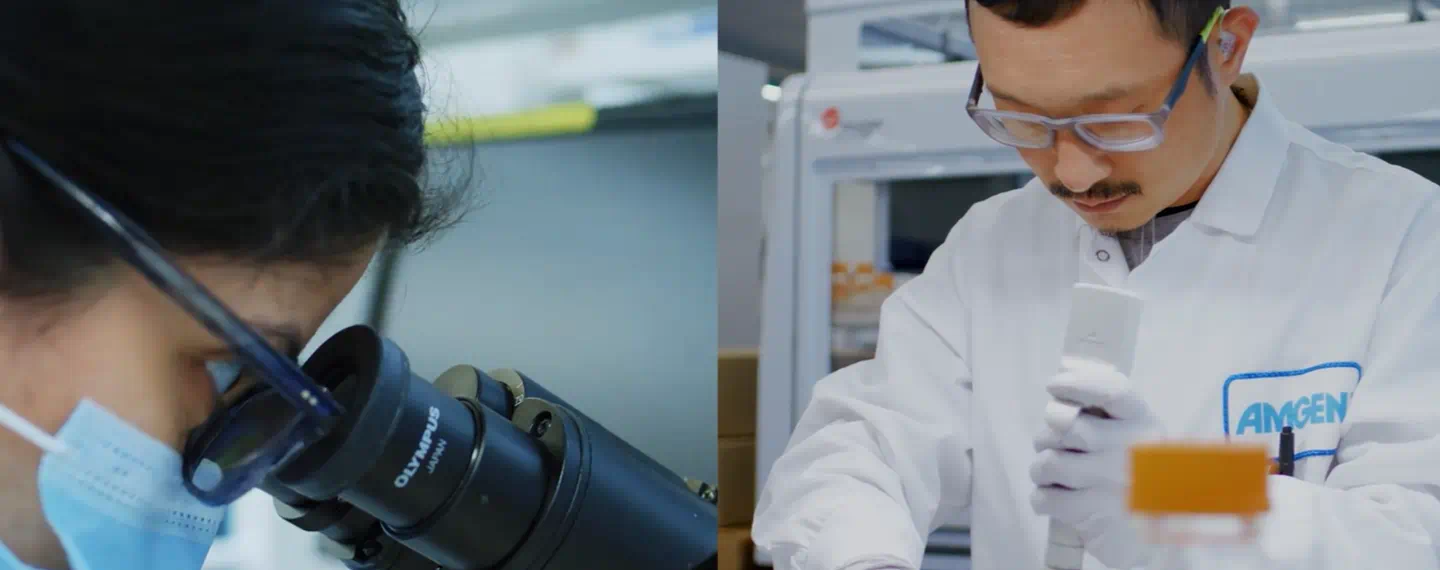
Backed by a $125 million investment, the facility expands Amgen's presence in one of the world's leading biotechnology hubs. Across approximately 50,000 square feet, the labs are purpose-built to support more than 100 scientists and equipped with advanced technologies—from high-throughput automation and robotics to state-of-the-art analytical tools—bringing science and technology together to advance discovery.
Designed to accelerate science
What sets this space apart is how it brings disciplines together.
Chemistry, biology, protein science, assay expertise, automation teams and data science operate side by side—enabling closer collaboration, real-time insight sharing, and faster, more informed decisions.
This integration improves both the speed and quality of learning. When teams review the same data and structures together, questions are answered more quickly and the next molecules and experiments can be designed sooner.
This faster feedback loop helps generate stronger data, identify promising drug candidates earlier, and shorten the path from idea to potential medicine.
Powered by the DMTA cycle
At the core is the Design-Make-Test-Analyze (DMTA) cycle—a continuous process that helps scientists design, test, and refine molecules more efficiently.
DESIGN
In Design, medicinal chemists work with computational chemistry and structural biology to explore ways to improve a molecule's performance, focusing on properties like potency, selectivity, and safety.
MAKE
In Make, chemists synthesize these molecules and prepare them for testing through efficient, streamlined workflows that produce assay-ready compounds.
TEST
In Test, teams evaluate how each molecule performs across assays, measuring properties such as target affinity, potency, and specificity, to evaluate whether those molecules are better or worse than the previous round.
ANALYZE
In Analyze, scientists review the data, apply modeling and machine learning where appropriate, and decide what to design next—creating a fast, iterative learning cycle.
This continuous loop helps teams learn faster, make better decisions, and move promising molecules forward with greater confidence.
"Great science starts with the right environment and the right questions. Our new small-molecule labs in South San Francisco bring chemistry, biology, and data science together so teams can work more seamlessly to invent medicines that matter. With integrated capabilities and advanced tools, we are strengthening how we design molecules and evaluate potential candidates—supporting early discovery and advancing scientific innovation in service of patients.”
- Margaret Chu-Moyer, vice president, Small Molecule Therapeutic Discovery
Built for impact
This investment is designed to deliver impact at every level.
- For patients: accelerates progress toward new therapies for serious diseases
- For science: strengthens the Bay Area as a global innovation hub
- For employees: reinforces investment in people, tools, and ways of working
This is more than a new facility. It's a foundation for what comes next in drug discovery.
Stay connected and be part of the conversation. Follow Amgen on social media to see how our science is advancing.


